Murder of Wheelchair-bound Kamal Zghair, April 10, 2002
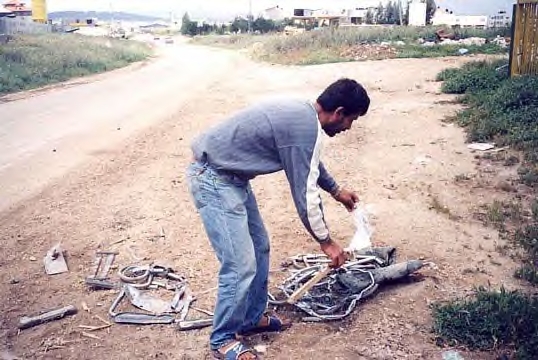
Kamal Zghair was a fifty-seven-year-old, impoverished wheelchair-bound invalid. He slept in a backroom of a gas station in Jenin, near the Ibrahim Haddad factory. Almost every day, he went in his wheelchair to a neighboring industrial warehouse where his friend, fifty-year-old Durar Hussein, washed his clothes for him, repaired his wheelchair, provided him with food, and also gave him some respite from his lonely existence.
On Wednesday, April 10, Kamal Zghair came to visit his friend Durar Hussein as usual. Durar Hussein explained how he washed his friend’s clothes and fed him, and then wheeled him to the main road when he wanted to return to his room at about 4:00 p.m. Soon thereafter, Kamal Zghair was killed:
“That day, he came to me in the morning as he came everyday. I cleaned his clothes and put them out to dry. At about 4:00 or 4:15 p.m., I pushed his wheelchair to the street. He continued to make his way to the gas station.... I had put a white flag on his wheelchair to make sure that everyone could see him from far away.
“I waited about ten minutes, because it takes him some time to reach the end of the factory [grounds]. I heard tanks coming from the west. So I got worried about him, because he was in the street. Then they started shooting from the tanks. I knew exactly where he was, and the shooting was there. At first, I thought they were shooting to tell him to move out of the street.
“The tanks came nearer and it was too dangerous to remain outside, so I went inside. The tanks stopped for about 45 minutes at the edge of the factory [grounds]. ... The tanks didn’t leave the area, they remained, so I couldn’t leave the compound to check on him. The tanks remained there all night.”
The next morning, the curfew on Jenin was briefly lifted. Durar Hussein immediately went to check on his friend:
“I went by foot, and in the place I had expected, I found his wheelchair, crushed by the tanks. I saw the wheelchair but not his body. I ran to the gas station where he sleeps, yelling, ‘Kamal! Kamal!’ I entered his room but could not find anyone.
“I went back to where the wheelchair was crushed, looking here and there. I had seen something in the grass [from the factory], and suddenly remembered this. So I went to check and in between the grass I found his body.
“You couldn’t recognize the body-his face was smashed and his legs were crushed. I only recognized him because of the socks that I had cleaned the day before.” 78
Human Rights Watch went to inspect the site of the killing and found the crushed and bullet-ridden wheelchair by the side of the road, its white flag still attached. The stretch of road on which Kamal Zghair was killed was completely open with excellent visibility, so it is unlikely that the IDF soldiers who shot him saw anything other than an elderly, wheelchair-bound man. Although Kamal Zghair was outside during a curfew period, the use of lethal force cannot be justified to enforce a curfew. This case raises concerns that serious violations of international humanitarian law have been committed, and thus warrants criminal investigation
Courtesy: http://free.freespeech.org/americanstateterrorism/palestine/jeninmassacre/HRWreportJenin.html