The
Killing of Iman al-Hams
Omar Barghouti
CounterPunch
October 26, 2004
click
here for printable
version
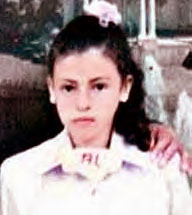
Iman al-Hams
Iman al-Hams was a 13-year old refugee schoolgirl who was executed -- after
being wounded -- by an Israeli platoon commander on the sad sands of Rafah.
According to testimonies given by soldiers in the same company to the mass
Israeli daily Yedioth Ahronoth, a soldier in the watchtower identified Iman
and cautioned his commander shouting, "Don't shoot. It's a little girl". The
company commander, the soldiers testified, "approached her, shot two bullets
into her [head], walked back towards the force, turned back to her, switched
his weapon to automatic and emptied his entire magazine into her." (1)
Eyewitnesses corroborated the soldiers, account, saying that Iman was shot
almost 70 meters away from the Israeli military position. After a bullet hit
her leg, Iman, who was wearing her school uniform, fell. Then, they said,
the officer went over to her, saw that she was bleeding from her wounds, but
still shot her twice in the head to "confirm the killing", an Israeli
euphemism for the practice of executing a wounded Palestinian. A cursory
army investigation later cleared him of any "unethical conduct", as is
customary, and suspended him only because of "poor relations with
subordinates".(2)
In a flash, Israel proved to the world -- yet again -- that it is not only
intransigent in its patent and consistent violation of international law,
but also incapable of adhering to the most fundamental principles of moral
behavior.
Three other children, almost the same age as Iman, were killed while sitting
in their classrooms in UN-run schools in Gaza in the past few weeks. They
were not caught in crossfire. They were not mistaken for adults. They were
shot to death as part of Israel's overt plan to collectively punish
Palestinian civilians for acts of resistance committed from their
localities, in order to incite internal rifts and resentment aimed at the
resistance movements. For instance, during the recent atrocious attack on
Jabaliya, ostensibly to prevent firing of the rudimentary Qassam rockets,
the Israeli forces destroyed houses, groves, infrastructure, water and
electric supply lines in a manner that was called "wanton" and
"indiscriminate" by the UN. Lest people fail to get the message, leaflets
were dropped over northern Gaza by Israeli helicopters, warning Palestinians
that "terrorism pushes you further into a life of misery and poverty."(3)
And your children will be hunted, too, the leaflets forgot to mention.
But why, someone may protest, should we judge Israel based on this one
incident, as heinous as it may be? A brief look at Israel's recent record of
purposely targeting Palestinian children will provide a compelling response.
The fact that more than six hundred and twenty Palestinian children have
been killed by Israel in the past four years should show that rather than
being a mere aberration, murdering Iman was the rule.
A look at the use of language, perhaps the most accurate gauge of a
society's moral collapse, will reveal the degree of racism that has gripped
Israel. Media outlets, politicians and even academics have seen fit to brand
Palestinian children as "enemies", "beasts", "tormenting attackers" and
"terrorists" throughout this intifada. The main motive behind resorting to
such dehumanizing diction in reference to children is a prevalent belief in
the Israeli mainstream that Palestinians are more than anything else an
imminent danger to be dealt with. They are a people born with a
predisposition to terror, as if due to some mysterious genetic disorder. A
child is then just a potential terrorist, a literal time-bomb. Studies by
prominent Israeli demographers often betray this attitude. Even some Israeli
army officials are appalled at the intentional killings. Ha,aretz quoted a
senior officer saying, "Nobody can convince me we didn't needlessly kill
dozens of children.(4) Hundreds is more like it. Some of the most
revealing instances will help substantiate this claim.
Even before the current intifada, in Hebron in 1996, an Israeli settler
fatally pistol-whipped 11-year-old Hilmi Shusha. An Israeli judge first
acquitted the murderer, saying the child "died on his own as a result of
emotional pressure., After numerous appeals and under pressure from the
Supreme Court, which termed the act "light killing", the judge reconsidered
and, as the Aqsa Intifada was raging, sentenced the killer to six months,
community service and a fine of a few thousand dollars. The boy's father
accused the court of issuing a "license to kill." (5) Gideon Levy of
Ha,aretz eloquently described the fine as the "end-of-the-season clearance
price on children's lives, referring to the findings of B'tselem, Israel's
leading human rights organization, which documented dozens of similar cases
in which perpetrators were either acquitted or received a slap on the wrist.(6)
In the first year of the intifada, several human rights organizations,
including the Boston-based Physicians for Human Rights, documented a pattern
in which Israeli sharpshooters have targeted the eyes or knees of
Palestinian children with a "clear intention to harm". Tel Aviv University
Professor Tanya Reinhart writes, "A common practice is shooting a
rubber-coated metal bullet straight in the eye -- a little game of
well-trained soldiers, which requires maximum precision." (7) Those
snipers, evidently, failed to see beyond their little, glittering target the
face, the person, the human child, and they "took them out with
professionalism". A New York Times journalist, who spent two weeks
monitoring the "clashes between Palestinian children with stones and
slingshots and the Israeli army with tanks and precision equipment at a
flashpoint in Gaza, wrote, "Never during the time I spent at Karni did an
Israeli soldier appear to be in mortal danger. Nor was either an Israeli
soldier or settler even injured." In that period, at least 11 Palestinian
[children] were killed during the day [time](8) by live ammunition.
Palestinian children have been fatally targeted in minor stone-throwing
incidences by professionally-trained Israeli sharpshooters, who only fire
with the intention "to hit the head". Because if a sharpshooter fires, "he
fires for certain in order to kill", as transpired from the breakthrough
interview Ha'aretz journalist Amira Hass (9) had conducted with a
"left leaning" sharpshooter during the early stages of the current intifada.
"Keenness to shoot", "lack of restraint", being "bored" or even "tired" were
among the key excuses he gave to justify his army's shoot-to-kill policy.
Citing the high incidence of killing or seriously injuring Palestinian
children, Hass asked the sharpshooter whether he or his colleagues had
intentionally targeted children. Adamantly denying the accusation, he
emphasized: "You don't shoot a child who is 12 or younger. Twelve and up is
allowed. He's not a child any more...Twelve and up, you're allowed to shoot.
That's what [our commanders] tell us."
The veteran American journalist Chris Hedges went even further, documenting
how Israeli troops systematically cursed and otherwise provoked Palestinian
children playing in the dunes of southern Gaza in order to shoot them. He
wrote in Harper's Magazine(10):
"The boys -- most no more than ten or eleven years old -- dart in small
packs up the sloping dunes to the electric fence that separates the camp
from the Jewish settlement. They lob rocks toward two armored jeeps parked
on top of the dune and mounted with loudspeakers. ... A percussion grenade
explodes. The boys ... scatter, running clumsily across the heavy sand. They
descend out of sight behind a sandbank in front of me. There are no sounds
of gunfire. The soldiers shoot with silencers. The bullets from the M-16
rifles tumble end over end through the children's slight bodies. Later, in
the hospital, I will see the destruction: the stomachs ripped out, the
gaping holes in limbs and torsos.
"Yesterday at this spot the Israelis shot eight ..., six of whom were under
the age of eighteen. One was twelve.... Children have been shot in other
conflicts I have covered -- death squads gunned them down in El Salvador and
Guatemala, mothers with infants were lined up and massacred in Algeria, and
Serb snipers put children in their sights and watched them crumple onto the
pavement in Sarajevo -- but I have never before watched soldiers entice
children like mice into a trap and murder them for sport."
Other than the direct approach to killing Palestinian children, Gideon Levy
also reports on another form of slow death: the medieval-like siege. When a
10-year-old girl from El-Sawiya village near Nablus experienced severe
abdominal pains, her father tried to take her to the nearest hospital in
Nablus; the merciless Israeli siege, however, blocked all possible routes
out of the village. In the morning Ella died from a burst appendix, which
could have been easily treated at any hospital.(11)
Whether at the checkpoints, in their classrooms, in their living rooms or in
the streets, Palestinian children have long lost any immunity they might
have enjoyed under an occupation that used to be particularly sensitive to
its image in the western public opinion. Alas, that was before 9/11. Since
then, however, with the effective Israelization of US foreign policy,
especially in the Middle East, Israelis felt they had a "windfall, as
Netanyahu called the 9/11 crimes in his first public reaction. Indeed,
Israel has steadily moved close to a combination of the French colonial
model in Algeria and the apartheid model in South Africa, while enjoying
unwavering protection from the new empire and a hypocritical, subservient
attitude from most European governments which continue to treat Israel as a
preferred partner and as a western outpost in the near east. Thanks to this
shameful collusion, Palestinian children are no longer spared Israel's worst
crimes, committed with revolting impunity.
When a nation tolerates, even encourages -- through failing to properly
investigate killings or punish perpetrators -- the deliberate, cold-blooded
murder of a defenseless child under the pretence of security, it does not
only lose any claim to morality it may have ever had, but also kills any
remaining argument for its worthiness to continue existing as a racist,
colonial state that is essentially above the law. It is the responsibility
of humanity at large, and the west in particular, to impose sanctions and
boycotts on Israel similar to those struck against South Africa in the past
in order to bring about its compliance with the precepts of international
law and the ever-evolving universal moral principles.
Iman in Arabic means belief. It is hard to guess why Iman al-Hams, parents
called her that name, but it may have been out of belief in their own
ability to persevere, to live and develop despite occupation, exile and
destitution. This belief lies buried with Iman in Rafah. With occupation,
there is no room for true peace, for progress, for decent living or for any
sense of safety. Palestinian children deserve life, freedom, dignity and
hope. At the very least, they deserve not to be executed by the region's
"only democracy".
Omar Barghouti is an independent Palestinian political analyst. His article
"9.11 Putting the Moment on Human Terms" was chosen among the "Best of 2002"
by the Guardian. He can be reached at:
jenna@palnet.com
REFERENCES:
(1) Chris McGreal, A schoolgirl riddled with bullets. And no one is
to blame, The Guardian, October 21, 2004.
(2) BBC News, 15 October 2004, http://news.bbc.co.uk/go/pr/fr/-/1/hi/world/middle_east/3748054.stm
(3) Chris McGreal, 23 killed in Israeli raid on refugee camp, The
Guardian, October 1, 2004
(4) Ha'aretz, December 12, 2000.
(5) Reuters, January 22, 2001; Phil Reeves, "Fury as court frees
settler, The Independent, January 22, 2001.
(6) Gideon Levy, Ha,aretz, January 28, 2001.
(7) Tanya Reinhart, "Don't Say You Didn't Know, Indymedia, November
2000.
(8) Michael Finkel, "Playing War, New York Times Magazine, December
23, 2000.
(9) Amira Hass, Don't Shoot Till You Can See They,re Over the Age of
12, Ha,aretz, November 20, 2000.
(10) Chris Hedges, A Gaza Diary, Harper's Magazine, October 2001.
(11) Gideon Levy, Ha,aretz, January 7, 2001.
Courtesy: http://www.palestinemonitor.org/new_web/killing_iman_al_hams.htm