|
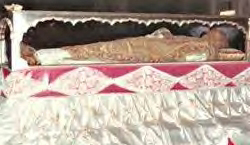
 Cradle The cradle upon
which the sacred coffin rests, was constructed by a lay Salesian
Brother at the Don Bosco Technical Institute in Panjim, and possibly,
even designed by him. The concept originated from the need to
isolate the coffin from coming into physical contact with the
bearers. The set of 10 frames that engird the cradle was incorporated
for the purpose of giving it an aesthetic extension. Cradle The cradle upon
which the sacred coffin rests, was constructed by a lay Salesian
Brother at the Don Bosco Technical Institute in Panjim, and possibly,
even designed by him. The concept originated from the need to
isolate the coffin from coming into physical contact with the
bearers. The set of 10 frames that engird the cradle was incorporated
for the purpose of giving it an aesthetic extension.
1964 Exposition
The cradle was first introduced  at
this Exposition, and the frames contained panels that bore the
inscription, "St. Francis Xavier, Pray for us",
transcribed in various Indian dialects. The section beneath the
panels was skirted with a richly embroidered fabric, in order
to minimize the imposing look of the tubular arms that constitute
the chassis of the cradle. at
this Exposition, and the frames contained panels that bore the
inscription, "St. Francis Xavier, Pray for us",
transcribed in various Indian dialects. The section beneath the
panels was skirted with a richly embroidered fabric, in order
to minimize the imposing look of the tubular arms that constitute
the chassis of the cradle.
1974 Exposition
At this Exposition, I was called upon to create a new set of
panels. (Click
here to view details of the panels)
The exquisitely embroidered satin skirt which drapes the cradle,
was the painstaking work of a devout nun from the Holy Family
Convent in Old Goa.

- -1974 Exposition
- Note Three days
prior to the official opening of the Exposition -- the late Fr.
George D'Sa summoned me to his office. At that meeting, he displayed
the now weathered 1964 Exposition panels and called upon me to
come forth with something more powerful to showcase the 1974
Exposition.
- Overwhelmed with the prospect
of producing something of such importance at such short notice,
I left the Basilica but not before humbling myself at the saint's
tomb and invoking: "Provide me with the inspiration and
I'll come through".
- The saint did
come through!
|
-
-
- 1984 Exposition At this Exposition -- for reasons unknown --
the Exposition Committee opted to display the coffin with the
frames and the cradle itself, completely shrouded amidst fabric
and flower-garlands. The picture below (assuming it pertains
to the 1994 Exposition) makes a fair visual representation of
the 1984 display, except that at the 1984 display, the choice
of fabric was saffron -- which choice, along with the mound of
flowers that cloaked the cradle, gave the sacred event the semblance
of a funereal pyre.
|
Note: Prior
to the 1984 Exposition, I had addressed to the attention of Fr.
Vasco Rego, the significance of the frames and the panels that
adorn the cradle. I also intimated to him that I had the 1974
panels in my keeping -- still do -- and that a) I could
provide them to him for reuse; b) graciously come forth with
a new concept or c) he could entrust the task to another artist. |

-
- 1994 Exposition At this Exposition, the coffin was similarly
displayed, with the frames and the cradle itself completely shrouded,
albeit, less funereal looking than the prior Exposition.
-
-
- 1994 Exposition?
-
-
- 2004 Exposition
- In light of the forthcoming Exposition,
it is not my intent to enlighten the Exposition Committee of
any residual grievances I might still have over the manner in
which the saint's body was displayed at the prior two Expositions,
nor will I be aggrieved should the Committee favor the same prototype
(i.e., shroud the frames and the cradle), or even if the Committee
were to entrust the task of creating new panels to another artist.
However, if the Committee should call upon my services, I would
like to alert the Committee that I am still graciously fit and
contributive in that creative realm!
-
 Secondly,
each time the Exposition comes around, I develope an ambitious
aspiration to see the statue of St. Francis Xavier erected in
the spot where Luis de Camoes once stood. The proposition to
erect St. Francis Xavier's statue in Old Goa was first made in
my 1985 article titled, St.
Francis, Abbe Faria and the Power of Wild Shrubbery, and subsequently
in my 1992 article titled, St.
Francis Xavier, Old Goa and the vacant pedestal. [Note:
The size of the statue appears oversized in relation to the buildings
due to the fact that it is in the foreground, and the proportion
itself slightly exaggerated for ease of view. I would envision
the statue (excluding the pedestal) to be in the range of 9-12
feet.] Secondly,
each time the Exposition comes around, I develope an ambitious
aspiration to see the statue of St. Francis Xavier erected in
the spot where Luis de Camoes once stood. The proposition to
erect St. Francis Xavier's statue in Old Goa was first made in
my 1985 article titled, St.
Francis, Abbe Faria and the Power of Wild Shrubbery, and subsequently
in my 1992 article titled, St.
Francis Xavier, Old Goa and the vacant pedestal. [Note:
The size of the statue appears oversized in relation to the buildings
due to the fact that it is in the foreground, and the proportion
itself slightly exaggerated for ease of view. I would envision
the statue (excluding the pedestal) to be in the range of 9-12
feet.]
-
- Over the years, I have attempted to
keep this proposition alive with the Archeological Survey of
India, and in 1996, I made this proposition in person to Dr.
B.P. Singh when he visited Old Goa, as well as presented him
with a copy of my aforementioned article, St.
Francis Xavier, Old Goa and the vacant pedestal. Dr. Singh was, at the material time, the Secretary
of Culture and then acting Director of the ASI. (see current email to the Director General of ASI)
- Should the Archdiocese be
keen in pursuing this proposition with the Archaeological Survey
of India, the State, the Central Government, or with any other
official entity, I shall feel duty-bound to offer any and all
assistance towards its realization.
-Dom Martin
|